Battery for an electric boat motor: which lithium battery fits? Victron and ECTIVE compared
10 lithium batteries from Victron and ECTIVE at 12, 24 and 48 V: capacity, weight, BMS, cycles, warranty, price per kWh and rules on third-party batteries.

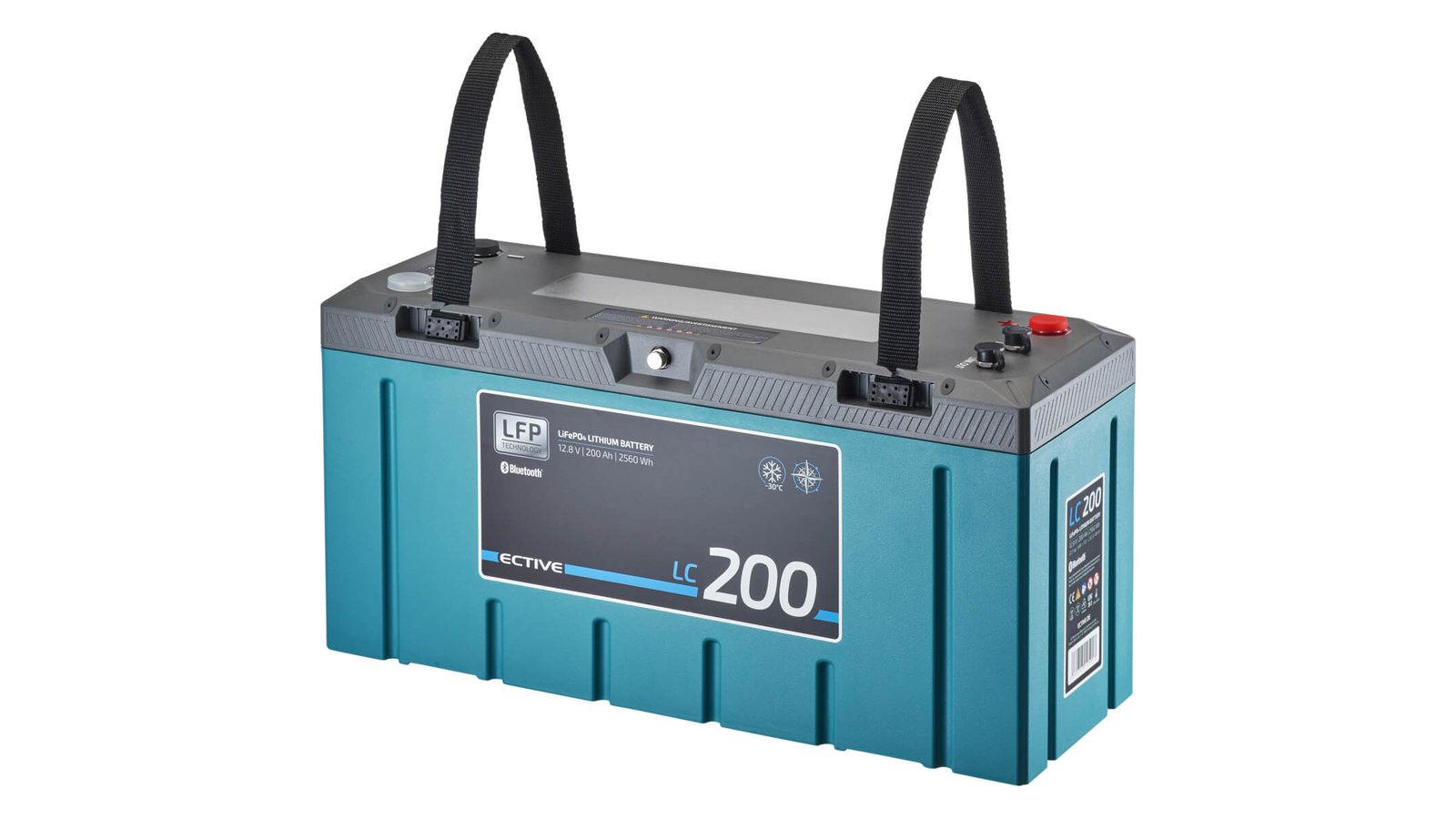
Which battery fits your electric motor depends first on the motor's voltage: the Torqeedo Cruise 3.0 and 6.0 and the ePropulsion Navy Evo run on 48 V, smaller motors on 12 or 24 V. Victron offers lithium iron phosphate batteries (LiFePO4) at all three voltages, ECTIVE only at 12 and 24 V. Depending on the model, a kilowatt hour costs roughly €220 to €650.
What voltage does my electric motor need?
The voltage is in the motor's data sheet, and the battery must match it exactly. Outboards in the 3 and 6 kW class work at 48 V; this applies to the Torqeedo Cruise 3.0/6.0 and the ePropulsion Navy 3.0/6.0 Evo. ePropulsion's X series from 12 kW moves up to 96 V (see our electric outboard comparison). For the Navy, ePropulsion requires a battery with 48 V nominal voltage and more than 62.5 A continuous discharge current (ePropulsion FAQ). Small dinghy motors often have a built-in battery, see electric motor for a dinghy.
Victron and ECTIVE: the batteries compared
All batteries here are LiFePO4 batteries. Victron lists its prices excluding VAT, ECTIVE's shop includes 19 % German VAT; we calculated the gross price for Victron and the price per kWh ourselves.
| Battery | Voltage | Capacity | Energy | Weight | BMS | IP rating | Price | per kWh incl. VAT |
|---|---|---|---|---|---|---|---|---|
| ECTIVE LC 100 Marine LT | 12.8 V | 100 Ah | 1.28 kWh | 13.5 kg | built in | IP67 | €399.60* (ECTIVE) | €312 |
| ECTIVE LC 200 Marine LT | 12.8 V | 200 Ah | 2.56 kWh | 22.5 kg | built in | IP67 | €779.60* (ECTIVE) | €305 |
| ECTIVE LC 300 Marine LT | 12.8 V | 300 Ah | 3.84 kWh | 38 kg | built in | IP67 | €1,499.40* (ECTIVE) | €390 |
| ECTIVE LC 100L BT 24V | 25.6 V | 100 Ah | 2.56 kWh | 24.8 kg | built in | IP65 | €573.06* (ECTIVE) | €224 |
| Victron SuperPack NG 12.8V/100Ah | 12.8 V | 100 Ah | 1.28 kWh | 10.7 kg | built in | IP65 | €700 net, €833 gross | €651 |
| Victron Lithium Smart 12.8V/200Ah | 12.8 V | 200 Ah | 2.56 kWh | 20 kg | external, required | IP22 | €1,068 net, €1,271 gross | €496 |
| Victron Lithium NG 12.8V/200Ah | 12.8 V | 200 Ah | 2.56 kWh | approx. 19 kg** | external, required | IP65 | €1,015 net, €1,208 gross | €472 |
| Victron Lithium Smart 25.6V/200Ah | 25.6 V | 200 Ah | 5.12 kWh | 39 kg | external, required | IP22 | €2,043 net, €2,431 gross | €475 |
| Victron Lithium NG 51.2V/100Ah | 51.2 V | 100 Ah | 5.12 kWh | approx. 37 kg** | external, required | IP65 | €2,135 net, €2,541 gross | €496 |
| Victron SuperPack NG 51.2V/100Ah | 51.2 V | 100 Ah | 5.12 kWh | 41 kg | built in | IP65 | €2,381 net, €2,833 gross | €553 |
Victron sources: price list 2026-Q4, data sheets Lithium Smart, Lithium NG, SuperPack NG. \* Sale price in the ECTIVE shop with a struck-through original price, as of 24 October 2026 (the LC 100 Marine LT, for example, was reduced from €799.20 to €399.60). \\ Victron gives the weight in the data sheet as an estimate.
Neither manufacturer lists prices in pounds. ECTIVE has no 48 V battery in its range, and its 24 V battery comes from the motorhome range, not the marine range (ECTIVE). For 48 V outboards, this comparison leaves only Victron or the motor manufacturer's own battery.
Does a battery with a built-in BMS cost more?
The battery management system (BMS) protects the cells from deep discharge, overcharging and overheating. It is built into ECTIVE batteries and the Victron SuperPack NG. Victron's Lithium Smart and Lithium NG ranges need an external Victron BMS that you buy separately, for the Lithium Smart for example the Smart BMS 12/200 at €224 net (Victron price list). For the Lithium NG, Victron specifies the Lynx Smart BMS NG (Victron). Every battery needs a charger with a LiFePO4 charging profile, and none comes with one.
How long does a lithium battery last?
ECTIVE quotes 4,000 cycles at 80 % depth of discharge, Victron 2,500 cycles at 80 %, 3,000 at 70 % and 5,000 at 50 %, after which the battery still has at least 80 % of its capacity (ECTIVE, Victron). On warranty, ECTIVE leads with 5 years, voluntary and, according to its warranty terms, only for consumers in the EU and for purchases from 15 December 2025. Buyers in the UK are therefore not covered. Victron gives 3 years, extendable to 10 years for a 10 % surcharge (Victron).
Can I connect a third-party battery to my outboard?
With Torqeedo yes, with ePropulsion only at the risk of your warranty.
- Torqeedo explicitly allows third-party batteries for the Cruise 6.0 R (48 V); you need the cable set with item no. 1990-00 (Torqeedo). According to the manual, only a qualified professional may install the battery, in line with ISO 16315 or ABYC E-11 (Torqeedo manual). We found no explicit warranty exclusion for third-party batteries in the warranty terms (Torqeedo warranty).
- ePropulsion calls third-party batteries “possible, but not recommended” because they do not communicate with the motor. If a fault occurs while running on a third-party battery, the warranty does not apply (ePropulsion FAQ).
Are there rules for lithium batteries on pleasure boats?
For pleasure boats under 20 m, we found no official rule on lithium batteries in Germany. The German Inland Waterway Vessels Inspection Ordinance only applies to vessels from 20 m length or 100 m³ (BinSchUO § 1). Its technical rules refer to the European standard ES-TRIN, which requires, among other things, the standards EN 62619 and EN 62620 and a BMS for lithium batteries. For recreational craft, however, ES-TRIN does not list this lithium article (ES-TRIN 2025/1). So follow the installation instructions of the motor and battery manufacturers.
Sources and image rights
- Images
- ECTIVE (conditions)
- Checked
- 24 October 2026 by Andreas Lakeberg
Know a rule, a price or a model we missed? Write to contact@voltnautic.com. We check every tip against the source and note updates at the top of the article.
Legal notice. This article is a general summary of regulations and is not legal advice. Only the linked laws and regulations in their current version and the responsible authority are binding, for example the navigation authority, the local council or the lake operator. Information checked: 24 October 2026.
Disclaimer. We research every article carefully and to the best of our knowledge. Prices, models and regulations change, so we cannot guarantee that all information is complete, current or correct. Please check anything important with the original source before you make a decision. To the extent permitted by law, we accept no liability for errors or omissions.